 Our aim was to drive from Verteuil to Cognac, then Saintes, then Royan and onto Île d’Oléron to stay the night. The next morning we would drive to La Rochelle and then onto Île de Ré, another island off the coast, before driving west back to Verteuil. All up, non-stop, this is just a six hour drive. The town of Cognac is only 55 minutes or 80km south-west of Verteuil and also sits on the Charente River. The town gives its name to one of the world's best-known types of brandy or eau de vie. Cognac must be made in designated areas around the town of Cognac and must be made according to strictly defined regulations to be granted the name Cognac. There are a number of Cognac houses that all have visitor centres. Cognac is a lovely town with pedestrianised streets in the centre, quaint and clean, with groupings of ancient half-timbered houses. We walked around the centre, had a coffee on the edge of the Place François I, and wandered along the river past the St Jacques gate constructed in the 13th century, the only remaining opening to the previous ramparts. Less than 30 minutes away and also on the Charente River is the town of Saintes. Now in the Charente Maritime department, Saintes has a long history. Of most interest to us is the first century Roman amplitheatre and the dedicated auberge to pilgrims of the chemin de St Jacques (camino). After a lunch of galettes and crepes we were on our way again to Royan.
 Marina at Royan Our favourite memory of Royan is learning that it is always important to check when you are ordering take-away pizza, to ask for the pizza to be cut into slices. It is not unusual in France for pizzas not to be cut into slices. I remember sitting on a concrete bench on a grey, winter day, overlooking the ocean, making a slimy mess of a beautiful, very cheesy pizza, pulling it apart with our hands, not having had the where-with-all to take serviettes from the vendor.
modernist architecture of the 1950s. It’s previous main church was destroyed in the bombing and was replaced by the eye-catching Notre-Dame de Royan. Completed in 1958 and built entirely of reinforced concrete, it looks amazing from both outside and inside. The church was classified as a historical monument in 1988. One hour north west and we crossed the almost 3km long bridge to the Île d’Oléron, where we will stay the night. Very popular with French holiday makers, it is a long, narrow island, and has one main road up the spine of the island which I imagine is a bit of a headache during the busy summer holiday period. The island is very flat (there is a lot of cycling going on here) and has a thriving oyster industry. This was our first visit here. There are about three little villages on the island - we stayed at Saint-Pierre-d’Oleron which is a vibrant village with lots of restaurants and cafes. It’s a relaxed, low-rise, sea-side strip, reminiscent of 1980s Bribie Island or Caloundra (another Australian reference).  Bridge across to Île d'Oléron. The next morning we are off to La Rochelle, a city on the Atlantic coast with a long history. There is significant Roman history, links with the Knights Templar, a significant role in the Hundred Years’ War and the French Wars of Religion, the Huguenot rebellions and with Nouvelle France in North America. It was a German stronghold in WWII, hosted a submarine naval base, and was the last French city to be liberated at the end of the war. I recommend watching the 2018 TV series Das Boot on the streaming platforms – La Rochelle was a prime location. You can spend an interesting couple of hours wandering around the centre, with its white stone buildings and colonnades, and along the old harbour front. Hundreds of restaurants and cafes to choose from, specialising in seafood, oysters, moules frites and Charente pineau. Take a hat, sunnies and sunscreen – the sun beating off the white stone can be vicious. Our original intention was to use La Rochelle as a jump off platform to Île de Ré, another Atlantic holiday island accessible by a long road bridge just to the north of the city. But the day was getting on and we have already visited Île de Ré a number of times, so we pointed the car east and wound our way along slower, secondary roads back to Verteuil.
0 Comments
Life in Charente is so relaxing, comfortable and enjoyable that a number of years ago we realised that despite coming here consistently since 2014, we hadn’t really seen that much of France. People often asked us if we had been to "such and such" a place, or seen another part, and we would have to say “no, not yet”. It was just so easy to stay in and enjoy the local area. Since then, we have made a commitment to go and see some new areas each time we visit. We have spent some substantial periods in Paris, and visited parts of Auvergne, Aveyron, Bas-Rhin, Gard, Vaucluse, Manche and Ille-et-Vilaine, Vendée and Charente-Maritime. One of our favourite areas is the Dordogne which is the department directly to the south of us in Charente, and therefore quite easy to get to.
We’ve been to the Périgord area of Dordogne quite a few times and often feel compelled to revisit. We headed down just before the high season, in June, and while there were lots of people around, it wasn’t “crazy-busy”, and we were surprised at the lack of English-speaking tourists. All the visitors and holiday makers seemed to be French.  Our road-trip from Verteuil to the Dordogne, and back. We notice that as soon as you cross the border from Charente to the Dordogne the gently undulating land and fields of grain, hay, rape seed, corn and sunflowers is left behind, and transitions to a much more hilly landscape covered by more forest. We have left the wind turbines behind, and notice that the villages and towns seem more plucked and coiffed. The stone houses and buildings have changed from the grey-white Angoulemois stone to the yellow-ocre coloured stone of the Dordogne river cliffs. Our first stop, as usual, is Brantôme. Brantôme, a beautiful riverside village on the Dronne river in the north of the department of the Dordogne. It is always on our list of places to visit and we have been many times - it never fails to impress. The town has a beautiful mixture of medieval and renaissance architecture to admire. The Benedictine abbey on the banks of the river is superb and the old stone bridge and the beautiful mill have been transformed into a hotel and restaurant. The abbey was originally built by Charlemagne in 769 and there is a troglodytic section behind the abbey built into the cliffs. There are plenty of places to eat, and for special occasions, spoil yourself and make a reservation at the restaurant, Le Moulin de L'Abbeye, a Michelin star restaurant. We have previously enjoyed two great meals on the mill terrace with attentive service and food that is a visual treat, all the while watching the ducks and ducklings on the river, and the canoes riding down the chuttes of the weir, on their way down the river. After a walk around the Friday morning markets, a coffee by the river and a quick look at the various galleries in the old converted abbey, we left Brantôme for Lascaux. Lascaux IV which is a fabulous reproduction of the nearby 20,000 year old cave art that was stumbled upon by a group of boys and their dog in 1940. We visited Lascaux II in 2014. Lascaux IV is entered through an amazing concrete structure – the French do Visitor Centres very well. This is truly worth a visit, especially for fans of “The Clan of the cave Bear” series! The large life size depictions of bison, cows and horses on the walls and roof of these caves are inspiring.
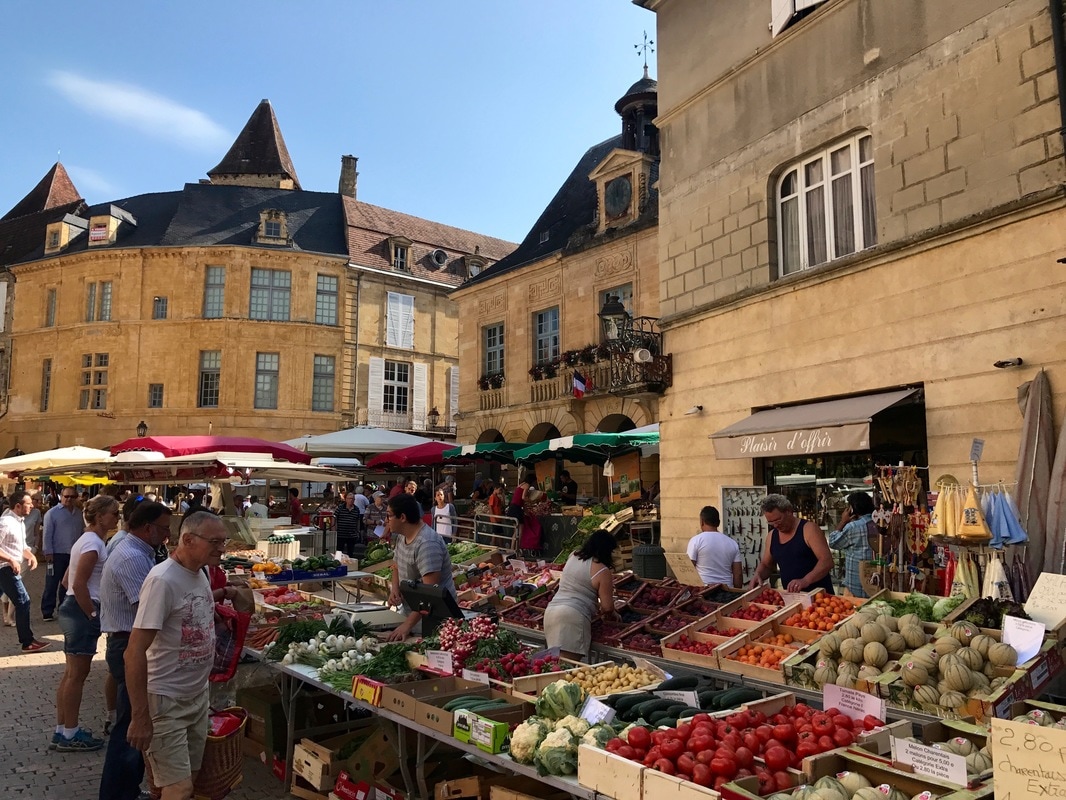
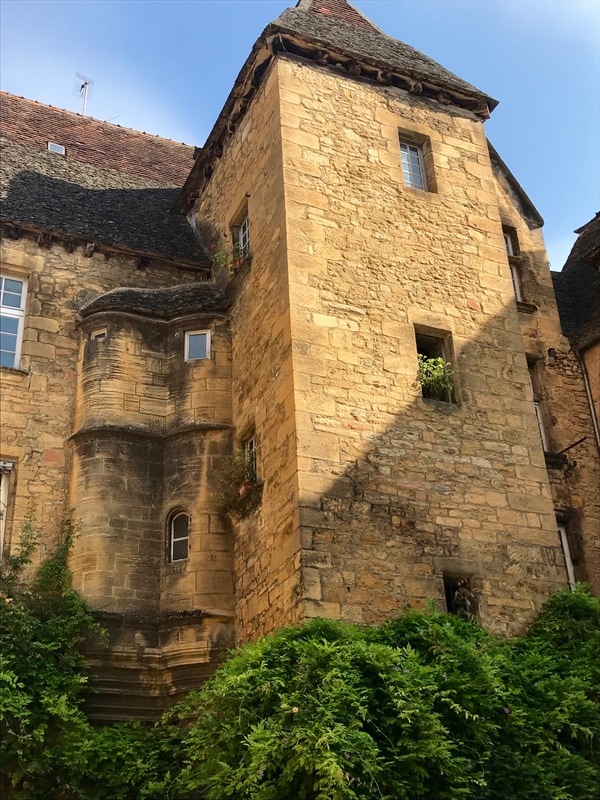
1994) was based in Paris but had a close attachment to, and frequently visited, the area. I remember having a large poster of Robert Doisneau’s Le Baiser de l’Hôtel de Ville on my wall in my student days. Sarlat-la-Canéda is a must-visit town. The market town of Sarlat is reknown for its foie gras - you'll see images of ducks and geese everywhere! It's a special, lovely old town, and the spring-board for this "special" region of France. It has been relatively untouched in recent centuries and as a result, Sarlat has remained preserved and one of the towns most representative of 14th century France. Try to arrange your visit to include Saturday, as it has a fantastic, busy market on Saturdays mornings. I am going to shamelessly recommend the little B&B that we stayed in – Noreli B&B – on the old town square, just 4 rooms, huge spaces, above a restaurant, friendly staff, and very reasonably priced. Sarlat is a great base to see the rest of the Dordogne River valley. Across a couple of days we visited some lovely chateaux and some other places which are worth highlighting. The Dordogne is scattered with ancient châteaux. There is not a place along the Dordogne River valley that you cannot see at least a couple of châteaux, many built on the cliffs of the river or on some other prominent high area, during the Middle Ages. While the towers and turrets of châteaux in Charente tend to be topped by conical slate tile roofs, those in the Dordogne are typically topped by pyramidal lauze stone roofs. The Château de Beynac is one of the best-preserved and best known in the region. At the time of the Hundred Years’ War, the fortress at Beynac was in French hands. The Dordogne was the border between France and England. Not far away, on the opposite bank of the river, the Château de Castelnaud was held by the English. The Dordogne region was the theatre of numerous struggles for influence, rivalries and occasionally battles between the English and French supporters.
collection of weapons, armour and reconstructions of siege engines and trebuchets.
in the Resistance during WWII. The story of the adjacent chapel in the grounds is also interesting as it describes the efforts of the current owners of the château in the process of restoring it, and how they worked with archaeologists, universities and the community to understand its history.
Domme is a little town that is well worth a visit and offers beautiful views up and down the Dordogne valley and river. It lies high on a rocky outcrop overlooking the Dordogne river and is a bastide, or fortified medieval town. Today, Domme is a member of the association Les Plus Beaux Villages de France ("The Most Beautiful Villages of France"). Domme was founded in 1281 and has a turbulent history. In 1307, the Knight Templars were imprisoned in Domme during the trial against them. During the Hundred Years' War, the bastide was coveted by the English who first took the town in 1347 and repeatedly changed rulers throughout the war until 1437 when it finally fell under French rule again. The Wars of Religion brought new turmoil. Protestants took the town in 1588 by climbing the cliffs at night to open the gates. Apparently this was a short success, as the Protestants handed the bastide back to the Catholics in 1592. Domme is a great town to wander around, take in the views and do some shopping in the artisan shops. Fun fact: On the subject of road trips, I read an article recently that it is often claimed that there are as many roundabouts in France as in the rest of the world! Approximately five roundabouts are constructed every day in France [The Local France: Inside France, 6 June 2026].
Living in France sounds exciting, exotic, something special to write home about. It's easy to romanticise a European lifestyle. But settling down for three or four months in another country, attempting to embed oneself into day to day life, is a completely different matter. Especially when you have the responsibility of keeping up a small house there, paying the relevant taxes and bills, trying very hard to maintain or at least not unravel reputation by unintentionally misinterpreting language, social cues, or just not understanding 'the way things are done around here". If you need to feel competent at all times, spending a prolonged period of time in another country will humble you immediately. Living in a different country and culture is a very different act to just dropping into a new, exotic place, taking the hop on-hop off bus past spectacular national monuments, and eating in lovely, quaint local cafes and restaurants. The act of "living" in a place is the Monday to Sunday of doing (read "surviving") the day to day life, where the successful completion of mundane, everyday tasks becomes a victory. Unfortunately, no one else is impressed that you figured out how the local refuse tip works. Iconic. Or that you successfully paid a bill on the french government web site. Revolutionary. Or that you have conquered making restaurant reservations over the phone in french. Give that man a slap on the back! Or that you successfully negotiated the emergency section of the local hospital. Outstanding! Understanding a joke in real time. Still pending. These are your peak moments now. Career milestones could never compete - you're just another foreigner who didn't stuff up a simple activity of daily living! You develop a split personality. There is the confident, reasonably intelligent, articulate you in Australia. And then there is French-you. French-you is polite. Constantly a little confused. Slightly panicked. French-you agrees to things Australian-you would absolutely never agree to, like waiting two months for a local bank credit card, or quietly accepting the orthodontist receptionist in Angoulême telling you that there is no available appointments for you between now and mid-July! Really?! Not one? Between now and mid-July? My response? Just a smile and "merci", and then a vitriolic, outraged download when I get back to the car. "This would never happen back home!!". [edit: well, maybe it would ...] You start sending out false messages, just casual, tiny, weird ones. Someone explains something and you nod "yes, of course, completely understood". You did not understand a single word. But you are committed now. You're in too deep. Let's just hope you don't get found out, that there are no follow-up questions or conversation that "finds you out". Back home you are spontaneous. Here you need preparation. Planning. A script. A backup script. Emotional support at the ready. Romanticism aside, the hard part of living the ordinary stuff in a foreign country is ... trying to work out installing and connecting an eSIM on your phone ... the plumber coming around and discovering that the installation of the new toilet is more complex than originally thought and will now take a couple of months to sort out ... breaking down on the highway in the Turo hire car and wondering what the f@#$ to do now ... having an elderly french gentleman accost you in the supermarket and start babbling at you in rapid-fire rural French something about my shopping trolley (I had actually inadvertently started walking away with his rather than my own) ... going out to anything - a shop, cafe, restaurant, anything, and in order to prevent disappointment, having to assume that there will be a "fermature exceptionelle" (an unannounced closure) ... trying to remember whether "essence" is petrol or diesel at the fuel station ... getting roused at by the owner of a close-by café because she thought we were pushing in on the queue (would never do that!) ... walking into some of the village shops that you have frequented often over the years, and being greeted as if you have never been seen before ... negotiating seemingly unreasonably complex parking meters and just hoping that you don't return to a car with a ticket ... having a conversation with the local barber that doesn't go quite as planned ... the constant on-going battle with the heating system and trying to understand how it works ... And all these examples? These occurred in the last 48 hours in real life, day to day life, here in Verteuil-sur-Charente, France. Challenging. Tough. Adrenaline flowing. Character building. But... as I mentioned earlier, you become very grateful for, and deeply invested in minor victories. Just in the last two days, we've had the madame who is renovating the old stone house next door give us 4 eggs from her chickens, and showed us through her house (always so interesting to see what is behind the shutters in these villages). Today, the wheelie bins that I believed I had arranged through the village mairie really did arrive. As promised. No delay. The mechanic arrived (twice) to fix our car and get it back onto the road. Two restaurant tables reserved over the phone for Friday and Saturday nights - straight forward, no repetition required. I picked up three cycad ferns from Lidl for our rear courtyard, and saw that they were three times the cost at another nursery in the local town. Win! Visited an old antique shop in the neighbouring town and the madame propriétaire mentioned that I had previously visited her shop and said she recognised me from last year! Negotiated a deal with an elderly monsieur to do some yard work next month for a reasonable price. Unheard of! A plumber arrived as promised (!!) and a plan is in place to install an additional toilet in our cave. Receiving nice compliments from my local french teacher. The pleasure of the local rural environment and scenary, and the history that hits you in the face as soon as you walk out the door. As someone I know has said, "The dream is the ordinary life you build once the fantasy wears off". This time in France is special, an opportunity that we remain so grateful for.
|
AuthorJim lives in Brisbane, Australia, worked at The University of Queensland until 2025, and enjoys visiting, reading and learning about France. 
Archives
June 2026
Categories |







 RSS Feed
